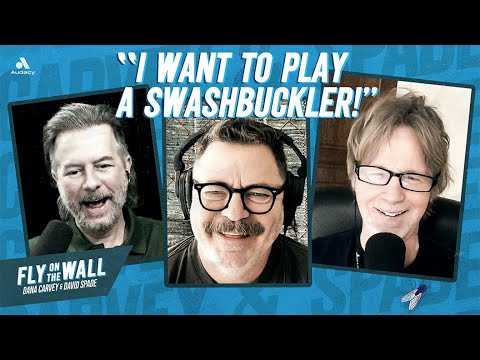
RE-RELEASE - Steve Buscemi
Ask about Fly on the Wall with Dana Carvey and David Spade
Episode Description
Let's revisit Steve Buscemi’s relationship with Sandler, SNL hosting stories, and the Coen brothers.
On Audacy’s Fly on the Wall, Saturday Night Live stars Dana Carvey and David Spade take listeners behind the scenes and reminisce about their favorite SNL moments, memories, and sketches with special guests.
Listen free: Apple: https://link.chtbl.com/fotwapyt Spotify: https://link.chtbl.com/fotwsyt Audacy: https://link.chtbl.com/fotwayt
Read the full transcriptHide the full transcript
- You know, Dana, um, we all know Steve Bushi. Yeah. Friend of the show, friend of the Happy
- Madison world. Uh, saw him at Sanders. Last time I saw him was at Sandler's Kennedy Center award. Yeah, we were I was actually next to him singing. I'd not really hung out with
- him and he's so much fun and so nice. You know, he's such an intense actor and we we talk about Fargo on on this movie
- and he can play the bad guy or whatever, but man, is he a sweet, funny person in real life and can sing pretty good.
- Good dude in everything. People really like him. He was in Con Air. I remember that's the part I
- Oh, yeah. I love that. And uh obviously I think it was Wedding Singer and Grown-Ups. Uh we did one
- summer. I think he was in both of them. Mhm. and just all around great actor, pretty beloved out there and does comedy, does drama and talks
- about everything in between. So, here he is. Uh, everybody Steve was young. Well, you were in Gronest, but the one I was in that I don't know if you This was the one you were in the cast. Which one
- is that? Is that both of them or is it I was in both of them. Yeah. Okay. Yeah. So,
- so the one where But Dana, this is boring as [ __ ] [ __ ] but I'm Me and Steve will crack up. You're
- already mesmerized. That's good. Okay. So, we're doing a drunk a scene where we're all around and it's night time and
- and uh we're all drinking and the couples start to pair off in slow dance and this Joe Walsh song comes on or something and I uh or not Joe Walsh but sentimental lady and I go, "Oh, no. Um,
- oh, this is a good song. And I and I'm drunk and I get up and I sort of stumble around and I interrupt Adam and Selma
- and then I wind up falling down drunk. But it's a seven-page scene and we're all in it. So, it's hard to shoot. So, we shoot it all night one night and we get to my coverage and they go, "It's
- getting light. We'll pick that up another time." And I'm like, "Another time?" Because I just had it all
- memorized because I'm doing it all night. I'm like, "I'm kind of glad I'm last because I have a lot of lines." So,
- three weeks later, McCartney is playing in Boston. We're pretty close. We might be in swamp squat. I just McCartney sounds.
- Yes. Sounds like I thought he was here. Everyone's looking around. When did he jump on? So, I go Chris Rock is in the movie and I say, "Chris McCartney is in
- Boston tonight." And he goes, "His ticket lady was my third grade teacher." And I said, "Oh my god." He goes, "Let's call her right now." And he goes, "We're all dialed in." I said, "We're done
- around six, seven." We haul ass. We found exactly when he goes on. And then he goes, "And he wants to say hi right
- before." We're like, "Oh my god." Wow. So about right before the end of the day, it was maybe Jack or someone came into my trailer and goes, "We're going to pick yours up tonight." I go, "Oh
- god, pick up my what?" And they go, "Remember, Jack, remember that scene you didn't finish?"
- I'm like, "Like like it's my fault." I go, "Yeah, I didn't finish it, right?" And he goes, "I think tonight's good." I
- go, "No, it's not. It's [ __ ] Paul McCartney." You're just not a worker. You know, you're not a real worker.
- Paul McCartney waited till midnight to go on. He's like, "Are they coming?" God, he's 81 and he's up for half the
- night. Yeah. So, I go I go, "Keep waiting." And then they go, I said, 'd do not bring that [ __ ] cast in to do all their [ __ ] again. I go, I'll do it.
- I said, I can't do that to them. So they gladly all scrammed. And then it was Sandler, you know, he's overseeing it.
- And then um I'm doing it to, you know, a bunch of like tennis balls or whatever the eyelines. And I do my whole seven
- pages. I'm drunk. And so I come to Video Village. This is sort of the point of the story.
- Yeah. And uh can't wait. And I'm like like Adam like we got it and uh yes I haven't taken any classes
- but yes I'm really good. And I sit there and he's just looking at it going. And I go we watch the playback and I'm behind him kind of chuckling like this is working. And then he goes were you
- drunker last time? Were you was it a little It was a little different. I don't know if it's matching. And I'm like, so I go,
- play me back something from the last time, you know, and I was and so we we're trying to go, okay. And it was
- really hard to match the exact tone of the drunkenness. Sounds crazy, but I go, I'm going to go under on this one. And then I come back and then I go, okay, I'm going to go a little bigger. And we
- did it until it made sense. Now, when you see the movie, you don't even notice, but it kind of fits in. Oh, you
- you notice I noticed when I saw it that you go he's medium plus David is a little drunker in this line.
- 30 seconds later he's slightly less drunk. Just play it six and a half Titos and
- Diet Cokes. And I'm like, "Oo, that's a big one. Okay, I can play that." And then um so that just shows you first of
- all, Adam's eye is always on the ball. Yes. And and little things like that matter and it's you can't tell yourself when you're acting and you need someone
- else's eyes to go, it was good. I just don't think it's exactly what we had. And and
- so it took a little bit of a collabing right there. And then that's kind of fun when you finish and you feel like you
- got it right and everyone goes, "Got it." And then you all go home and you go, "Got it. Got it." And you just knock it out. I have two questions for you.
- Did you make it to the concert? Not a [ __ ] chance. It was till 2 am we did that. All right. Well, I guess my second question is not a question. It's it's a comment about Adam because I agree with
- you. He's always so involved in like, you know, all the all the films. And I said to him, why don't why don't you
- ever direct? Yeah. I said and he said he didn't doesn't want to location scout. Like that was the extra extra work. Yeah. That was the reason. He works morning, noon, and night anyway. I mean there's
- block. He's reblocking. He's doing things that directors all do. So I think he's listened to so much indie
- Wayne. It's sort of just uh you know uh given that he's going to have a lot of say, but uh I guess you're right. It's that extra. Well, it's a little bit like Saturday
- Night Live. If you write a sketch, you're sort of the de facto director. We had Dave Wilson. He's setting up shots.
- He's he's got just it's live. So that it's not you, but you're still kind of the boss of your sketch. You're the
- producer and the director. If you wrote it, you're casting it with other cast members. And Sandler is like that. He's
- like a co-coirector. I mean, you sort of everyone knows he's the overarching creative force. He's got his eye on every ball. So um I think the way he did it was brilliant. You know, I don't
- think anybody else in history has done that many movies where they are in a sense an aur, right? It it is Adam, you know, and uh
- he puts his stamp. I mean, definitely when he he the fact that he actually cares and
- even when we're doing movies where you think this will probably not get good reviews just because they have a sort of
- bias, he still puts everything into it and really cares. I mean, another grown-up story is Do you have a half hour is um We'll get We'll get to you in a minute, Steve.
- No, Steve. So now we're gonna ask David for I want to ask Stephen when did he get fitted for the full body cast and what
- was his reaction to going wait what do I do here or do you see the script and go uh oh
- yeah I I could tell I was yeah in that one even on the day like because I remember and and the whole cast was there you know because it's like one of the big scenes and it was and it started
- to rain and they got the scene and then everybody just scatters. I thought these
- are like I thought we were friends. Like are we You're left out there in the room. Nobody's checking on me. Like everybody
- just like And then uh the ad. Then I thought I was done. And the ad said, "Well, I think they want to get a shot where the dog comes up and sniffs your balls." And I
- actually got mad. I went, "Are you [ __ ] kidding me? Are your Are your real hands in the real sticking straight up like goalpost or do they put fake hands in there so you
- don't have They put fake hands in. Thank you, God. You couldn't move. Thank you, Jesus. I thought it was real
- until right now. I just went, "Wait a second. Could you hold your hand up all day?" Because also the thing about it,
- when you're like that, like if I was seen like that, I go, "Well, obviously they're going to shoot me out first." And no one even gives a fat [ __ ]
- They're like, "Nope. Oh, Bushami, we never picked up. We'll get him at the end. Just sit there in the rain. We'll
- come to you while you're rotting and getting rusty." Yeah, it is tough. Movies are so complex and especially grown-ups, you got 55 leads.
- Oh my god, there's so many people Yeah. that are on set and I don't know how the producers and the ads do it, but they
- somehow manage. And just just for the people, young people listening that are in the groundings or whatever and
- aspiring to have a career in television or movies, we understand these are first world problems.
- Sure. Stupid. But but um the thing is you're on a movie set. I would say the most tired I I ever been I was because it was one of those 21-hour days and they said, "Okay,
- G's going to go in the diner. I'm going to do this thing I worked on for weeks, this dance." And I'm going and I was
- young and fit. I go, I am as tired as I've ever been in my life. I've been up like 40 hours and here's your shot for eternity. Go for it. Oh, at the very end of the night they
- get you. Yeah. Well, that's with Steve's film. I'm assuming like Woody Allen would do like night shoots would end at 8:00.
- Let's, you know, I think we should get some Chinese, you know. Did you uh were you able to have civilized hours in a
- sense for the listener? Pretty much. Um, but we know we wanted to we we knew we had nighttime shots so that by the end of the week we were going to
- be uh shooting outside. So, you know, we started at the beginning of the week normal hours and then each day we would
- just start a little bit later. By the end of the week it was it was night shoots. Going to splits lingo lingo. Going to
- split. You know, I wasn't going to say splits. Splits is lingo and I want the people want to hear it.
- First of all, we were watching your uh movie this morning. Uh this is The Listener, right Dana?
- The Listener is a heavy film. Uh it's very very interesting. The conceit of it, this this volunteer helpline woman. I I mean, we'll talk to a minute. It is
- your movie that Steve directed. It's very it's compelling. it and it it just kind of captures the angst uh post-pandemic angst or just human angst
- uh and sadness. It's it's extremely well done and well acted uh by Tessa Thompson
- who is the only actor in the film. You go ahead, Steve. Well, she's the she's the only actor
- that we see in the film. Thank you. There's an amazing cast of callers. Yeah. She plays a home helpline worker.
- She works the night shift. She works from home. And um she gets all these calls during
- the night that she navigates and uh and we have a wonderful cast that of the callers, but you only hear their voices,
- but you and you only see Tessa on screen for the duration of the film. And she's
- amazing because they are characters also. And they uh I was watching it with someone
- and the first guy that called in, she was more into the guy. She was like, "I like his voice. I like his tone. I like what he's saying. I like this guy." And so, it's
- actually a big challenge to be a voice and to have any sort of resonance or impact. And Tessa's obviously great on her end. She's got a very calm, soothing
- uh voice. And she's, you know, she could get very riled and it seems she's got a
- very uh you have to to have that sort of job. That's what her whole job is. And uh very interesting. I think what she worked with was, you know, because we did everything we
- could to make it cinematic. You know, if this was pre- pandemic and she was at a call center where she was, you know,
- kind of tethered to a desk, I don't know how I would have made made that film. But because she is a is able
- to work at home, we purposefully found a location that had a nice flow to it that she could walk around, be in
- different rooms, go outside, and uh yeah, what's amazing about Tessa is that yeah, her voice was, you know, she always tried to keep, you know, like a calm level tone, but then but you could
- see on her face if she was upset about something that somebody said or worried. Um, yeah, she
- had a lot of these uh micro expressions uh that you know sort of gave you an inkling of of what she was going through herself. And you know what you really captured
- which you do a lot when you're young anyway where you'll like a girl or something and then you'll talk on the
- phone at night. It's very intimate. It's c and these two people Tess's character and the strangers
- calling in. They don't know each other. It's very dim. It's the middle of the night and they're having this intimate
- conversation and the voice actors immediately the first one just sounded very just extremely real like your ease
- dropping you know you captured that. So thank you. Thank you so much. I appreciate you guys watching it.
- Yeah. Uh you know the voice is first of all I kind of want to ask you one other question but about this but
- when I was on the phone as a kid or dating or doing anything in life the voice was kind of a fingerprint. So when
- I think of women I've dated in the past or present, a voice is one thing I really appreciate in people because they
- are fingerprints. It's so unique and you I think I was brainwashed growing up like trying to talk to girls on their
- phone and talking for hours so many liked and you always remember that and sometimes people get older and everything but you know their voice
- right away, right? And so when I go into 7-Eleven and if I ask for something they go, "Oh, I was waiting to hear you talk. That is you."
- So you know it's kind of interesting. So when you have people call in, it's very powerful to have the right person with
- the right because you have to make them all a little different. And true. Yeah. Yeah. That's a trick. And then you have to make
- for people that don't know that sort of indie uh budget is like if you have one location, what you were saying is you have to use some trickery and some movements and some things to keep it
- alive. And you did that. And that's the hard part with one subject and one um location. It's it's an it's less expensive, but it's very it's hard to keep it going. So, to make a good movie
- is tough. We also we also shot the movie in six days because Essa was still working on Westworld, the HBO show that Oh, okay.
- and that was her hiatus. She had seven days off and she chose to work with us. you know, we were trying to find a window and she's so busy um with other films and other things, but she had that
- one week off. So, we shot the entire film in that one week, which was doable because it is a confined space and one actor, but still it was it was it was a
- bit of a challenge. And another interesting uh layer frequency, I don't know. I didn't I went
- to state school. um is this idea when you take on a role like when you see a teacher outside of school, you go, "They're just normal. What are they doing?" So, in this case, her character
- is has her own issues and yet she's in the helper mode. It's like when you have a therapist and you kind of wonder
- what's going on with them, you know? So, that was a whole another layer to the film that the people don't, you know,
- she's just in the helper mode and then she's in that mode, but she had so many other issues herself. So
- yeah, I mean I think most of the people who do that work have been through it themselves. And part of the conceit of the film is that Tessa's character, she breaks
- protocol because you're not really supposed to tell, you know, your personal story to
- callers, but she does so for this one call where this woman is in crisis. And um she reveals, you know, a lot about herself in order to uh help or
- save the person that she's talking with. Um, but I know what you mean about the,
- you know, seeing people out of context, like seeing your therapist on the street or I remember when I was a kid, I went
- to Catholic school and I remember one time during lunch seeing my teacher who was a nun eat a sandwich and I was blown away. What you eat?
- It's true. You never see him eat. They never eat. I saw Pastor Jerry. I was raised Lutheran. uh Pastor Jerry at the mall
- and he's wearing desert boots and I go, "Pastor Jerry wears desert boots because those were very cool back in the days."
- You know, I saw a rabbi on a pogo stick and I was like, "What are you? You're never on that." Um,
- right. I know. You know, Steve, I'm looking at this. There's so much Dana about Steve that we
- love because he's uh Oh, actually, one more question about the movie before I get into your illustrious I
- I have a question about the movie, too. Okay. My last one is being a wellknown actor and a name and
- uh I don't want to hype you up too bad, but you know, you direct and you're uh well-liked guy out there. Is it still
- hard to get a small movie off the ground? Yes, this is the first film I've directed in 15 years. Um and there were others along the way that I tried to do.
- This one was, you know, hard to get off the ground as well. We um but yeah I think the climate out there is tough for any filmmaker um but you know but uh where there's a will
- there's a way and we did it you got through it single single location helps with the budget and were you like I was just as a
- you're making film first film in a long time and now it's it's it's digital digital
- playback and you're going you got six days and so you're with your DP or your producer whatever and you're looking at
- stuff and are you going at some point, holy [ __ ] this is awesome. Or you're being self-critical or I I just wonder
- what you want us uh who will enjoy the movie. What do you What did you want us to feel? What were you trying to reach for? And do you feel that you got it? Yeah, I just I wanted to create this
- really intimate atmosphere and have Tessa's uh the location be totally her her world where you're getting clues about her. um
- and and for the the audience to want to lean in and and and be involved and it is
- exciting that on set. Um, it's also overwhelming because there's so much uh dialogue in it and uh so I'm
- constantly thinking, you know, I I try not to think of the editing process while I'm doing it, but yeah, I mean that's things that you have to think
- about. Uh, and is it is there enough movement? Is there is you know when should it be still? when, you know, when
- or if the camera should should move, when should Tessa get up and move around? And um so we spent a lot of time actually working that stuff out before
- we before we shot it. Did you ever once on the set after a take just go, "What are you doing?"
- And like Sandler, you sound like Sandler. I want to ask a question because Steve's been famous for a long time. So, it's hard. You're kind of okay. I get to talk
- to Steve. It was so much fun hanging out with you and at Sandler Singh in DC, you know, because
- you're one of the people I'd say uh Steve Bash's here. You know, I'm doing this thing with Steve Bash and it's like
- what? You know, it's like But I just here's something maybe you've never been asked. Who's more talented,
- Joel or Ethan Cohen? You have three seconds. Go. They're both hacks. Who likes feet more? Whon Tarantino or
- anyone else in the planet? Is he like feet or is that like a fake thing or is that like a joke?
- I don't know. I I I I don't I if he did know, he wouldn't tell you. Well, no, he can like feed. It's fine. I like things. Yeah. I just don't know if that's, you
- know, how much or Okay, we've got a We've got a what's it called when the witness is being very troublesome. I'm a hostile. Hostile witness.
- We We're trying to trend, Steve. We're like, no one knows we exist. We have a sweetheart deal with a F
- feetinder. Okay. I I'm reading this. This is what I read about Steve Bushi because there's so much to know about him.
- I know this guy goes frequently plays fast talkers, frequently plays cowardly characters. It's funny. And often characters mixed up in crime.
- Yes. All true. A little generic, but all true. They're just Steve is in so many good movies and he's so someone that everyone thinks is cool, which is where
- what I'm going for. Not there yet. But I think like Conair, cool [ __ ] movie. Just a random movie.
- Conair fun big movies. I miss those kind of you get to work with Nicholas Cage and his whole Nicholas Cage thing. It's great. Um, you remember that movie?
- I've had a great cast. John Malkovich and Oh yeah, yeah, yeah. Danny Tjo, can't you tell that he's lying? No, I'm I'm working on a Malovich. Uh, Nicholas Cage. Why? God, why? Um,
- oh, you know, Dana, to bore the [ __ ] out of Steve again, not to bring it back to me. And it's not about me. I do not care.
- I'm timing you this time. I read three times for his part in Conair. For whose part? Yours. And you probably was an offer.
- I'm sure you got offered it while you were milling it out and swishing it around. They were dragging me to the
- valley back and forth going, "Do it like this, you monkey." And then uh they go, "No, we got our guy. Thanks. Bye."
- I never knew that. Wow. You would have been I have a Steve. When's the last time you
- auditioned for a movie? Yeah, good one. Oh, wow. It's been a while. I I yeah I remember auditioning for a movie and then
- reading, you know, reading one of the parts and then asking the casting director, can I read for the lead? I was
- like, why? You know, and she looked at me and she said, oh no, we're going to get a name for that. And that's the first time I ever heard that expression. We're going to get a name
- for that. Like, well, I have a name. And then I thought, oh, I see. I have to get
- my name known. I didn't know it worked that way. I just thought if you were Oh, so many things I auditioned for were
- offers out to people and I was jumping around to kill time to scare them like we're having auditions right now. I
- mean, no one no one's good yet. Don't worry, no one's good yet. I hated when you walked into an audition room and I
- saw all these this is in the 80s. Babyfaced men with no chins. Like I go, "Okay, I get it. Oh, I I I get the look." Yeah. They're all look alikes of me. No
- chin, baby face. Okay. Cherubic. I get it. But they I I was over for 150 at one point. 150 auditions. And I've got one time the agent called me. You didn't get
- it and you frightened them. Oh, I remember auditioning for Barry Levenson once and reading, you know, reading this part and he liked it. He went, "That was
- good. It was good. Now, can you do it?" And he gave me a very specific direction.
- Did it again. Exactly the same. And we both looked at each other. I was mortified. He was embarrassed. And I And I said, "That wasn't that
- different, was it?" She went, "No, no, okay. Okay. Can't take direction." My [ __ ] acting coach shocked. Yes, I had one.
- They said they might give you direction just to see if you can take direction. A lot of people can't. I'm like, why not?
- And they're like, it's shocking. They can't. They go Stemi. They just start listing people.
- But honestly, it's like you just say that and you go, oh, I would just change it. And some people are coached so hard
- or they're with their teacher or whatever and they go, this is the right way to do it. even to the director. They're like,
- "I've got the right way. You don't." Right. And they're just testing you. But I've done that. I bomb every every commercial
- audition. Even more embarrassing. Um do do the Cohen brothers give you a line by line reading
- like say the line like how are they, you know, their writing is so specific, you know, that they really want you to, you know, say what's written. And so there's very little. I
- think I improvised something once on Fargo and I was nervous about it, but they liked it. But I remember in the
- beginning when I first started working with them, they uh I think in Miller's Crossing that they just wanted my
- character to be even, you know, he was a fast he was the fastest talker that I think I ever
- It's hard with lines to do fast. Yeah. And they just wanted it even more like they just wanted it more intense or more shrill. And um I remember doing the
- scene where I, you know, all I do is talk talk talk talk. Gabriel Burn had like two
- words, then I talk talk talk. He would just wait till I stopped talking, then he would say two two words. And there
- was a whole casino of people behind me uh on my co coverage. And I remember on one of the takes, my late wife Joe, she came to visit me on set, but I didn't know she was there yet. And as I'm doing
- the dialogue with the whole casino, you know, extras behind me, I see her head poke out, you know, behind somebody to watch. And I just stopped talking.
- Oh, through you. And all right, back to one. You know, and it was you hear a lot of rumbling
- and she felt horrible. I could see the look on her face. She knew what happened and she just ducked back out. Um,
- yeah, because your brain just switches. You go, "Wait, oh, Joe." Yeah. Turns you off.
- You know, uh, Dana, I don't know if you remember this one. Of course you do. I don't know who you played in this. Maybe
- Travolta. One of my favorite sketches was Welcome Back Cotter. Tarantino's Welcome Back Cotter.
- When uh, John hosted when John Oh, it was John was playing John. Okay. about hosted and it was welcome Back
- Carter directed by Quentyn Tarantino and um at the end of it yeah because Michael McKeon was on the show and they had Lenny and Squiggy pop out remember and then I came out at the
- very end as Mr. pink and said something like up your hole with a jelly roll, something like that. I remember in the rehearsal uh or the dress the dress rehearsal show
- uh I was late getting out there and I didn't think it was my fault. I thought I was cued late. But you probably don't
- remember this, David, but afterwards you did give me a little [ __ ] about that. Shut the [ __ ] up, did I?
- You gave me a little bit. A little bit. You did. You did. You were like, "Hey, the you know, Johnny on the spot there.
- What happened?" Something like that. And I went and they didn't kill me. You know, how dare I? I I was I was nervous.
- Nervous. I was Horseshack and I was in character. I got to play Horseshack. It was I loved it. I thought that was such a funny idea, funny sketch.
- It was great. Yeah. One of my all-time memorable ones. That's fun you got to be in that. And um
- I just watched your monologue of character actors. That was a good idea. You were people in the audience, cast members were character actors. Yeah. Asking you how to be a lead.
- Wait. Yeah. They said like, "Hey, you're a lead, but you play a lot of character
- actors, but now you're a leading man. I play the girl with all the bags at a store that's the best friend." And and
- then she frat falls out of frame and then Kristen Wig is like, I'm the girl running from the killer with a knife, but I don't know where anyone is. Steve, are you here? So, everyone was playing a
- character and they were asking for your advice to get past being a character actor. I thought it was pretty clever. I
- thought that was good. That was good. I should watch that again because I totally blanked that out.
- I'll send you a link. Sure. Thanks. All right, let me ask you a question. But now that you say it, now that you describe it, I do do I do remember it. Yeah. I mean, it is a blur because you've got
- 13 sketches. You've hosted I think twice. Twice. Yeah. Yeah. So, it's hard to remember every nook and
- cranny, but it was a good job. I thought that was interesting. I like what I remembered about the first
- time hosting during the dress rehearsal, I came out to do the monologue and I spotted a
- friend of mine from high school sitting in the front row. And again, it was just like seeing seeing my wife on set. I
- looked at him and I was like, "Hey, it's Eddie." And I was like, "Ah, [ __ ] What's my like I don't know what to do
- now." On top of your nerves. You see that throws you off. So scary. One take. That's the hard part. I know. You're like, "Let me start over." Nope. But thank God it was a dress rehearsal.
- And then at the for the show, I just went just told myself, just don't look at anybody. Just avoid eye eye contact.
- Yeah. Yeah. So, what a run you had in the 90s. I mean, it come and then SNL calls. You'd
- been in at least five giant movies, Reservoir Dogs, Pul Fiction. Um, when did Fargo come out? Yeah, that came out like in 96. I was surprised that I got the call for it
- because I didn't think I had really done enough to like warrant me being like that people would even know me. Uh but John Toutur was also on that year and I
- thought, "Oh, is this the year that they're like going after uh independent film actors or something?" And I I was like, I'm so thrilled to like get it, but I
- was nervous that uh I think I suggested because in the opening monologue, it was
- some monologue about my name, Steve, and something, you know, it was and it just wasn't me and I was nervous about that.
- So, I sort of addressed that and then I suggested something. I can't remember who came up with the idea that we were gonna like I was going to take suggestions from the audience and do
- like an improv with the rest of the cast and then I would just insert scenes from
- movies that I was in. But part of but the ulterior motive was to like to remind people I was in Fargo where
- Reservoir Dogs were nervous that people wouldn't know like who is this guy? Um but I was glad that they changed it. I was very sort of shy to say can we do I have to do this opening monologue
- can can we change it? and uh and Lauren was really open to it and and receptive and but that first time you host it's just it's just so uh mindb boggling. I
- was so anxious and I didn't know if I was allowed to say anything or contribute and even though they were
- asking me like is there anything that you like to do or you have any special talents can you sing?
- Yeah. Whatever you want. Right. Do you feel like you're being a problem if you say too much on a set?
- Yeah. Yeah. And then also like what do I know? Like aren't like you're the experts.
- Yeah. You put yourself in their hands. I think they just test you to say we have a sketch we've been sitting on, but we
- need someone that can speak Russian or we need someone that can, you know, sing and they and Yeah. And you need just
- dialects and weird [ __ ] And you go, I can juggle. They go, okay, we can put that in something. And then right, that helps. Did Did Lauren calm me down
- or is he sort of imposing in his own way? But normally he would really take a host. You go to dinner with him. You'll
- be nervous on the dress rehearsal and then on air it'll all just come together. That's Yeah, he's kind of both. He's very intimidating and comforting at the
- same, you know, kind of at the same time because he's so calm, you know, that like and it's no, this is what we do and
- you'll be fine. And it's like, okay, I'll believe you. Do you you know, we had a an old movie you did was called Airheads. I saw it again on the flight because we had
- lovely Brenon Fran who was a super sweetheart. Uh he's great. And then uh or Sandler
- for seeing Airheads Again because I went and saw it on uh Broadway in like 69th wherever there's that little theater in New York during I think it was SNL and it I saw the whole thing again. Pretty
- fun to see the whole thing again. Um and Billy Madison of course is such a big one that people remember you from you know I did one day on that movie on
- and everyone remembers it. Is that you when you cross the the list of kill who to kill that thing? And then Yeah. Yeah.
- So memorable. He he calls me up and he apologizes for his bullying behavior in high school and
- then I cross his name off the people to kill to kill and then I for no reason at all
- I just put on lipstick which that was my favorite part. You know we went Do you think I mean Yeah. Being the character actor is great. We saw Sandler tape his thing. I
- thought I might see it. He's doing his um stand up special. I know. And uh Bridget was there.
- Yeah. Veronica Vaughan, the teacher in Billy Madison. And uh and I said, "You get to be for history in one of Farley's funniest things,
- saying that Veronica is one fine piece of ace." And then Billy goes, "You went with her?" And he goes, "I had a couple fun nights with them." He goes, "No, you didn't." He goes, "No, I didn't."
- Or whatever. He says, "It's so funny. It's very, very, very Chris." Yeah, it was. Yeah.
- He plays the bus driver in Billy M. So funny. Yeah, that's fun. It's fun to be a part
- of even like that one scene you did just everyone remembers it. I loved and you know Yeah. And Chris was in Airheads. And I remember when we did
- the read through and afterwards, Chris said to me, there's a part in Airheads where, you know, like my character gets angry and I'm like yelling at Adam and and uh
- Chris says to me, "Wow, Steve, when you were yelling that one time, you you sounded just like you did in Reservoir
- Dogs." And I kind of looked at him like, "What are you saying?" And I realized Chris really was that way. Like when he
- had that sketch on SNL, he was, "Oh god, what?" You know, remember when you were in the Beatles?
- Yeah. Yeah. Yeah. He really was that way kind of, but he was excited, I'm sure, to see
- you. I know. I know. It's fun. And and I just, you know, and and I kind of looked at him and he looked at me and
- and then we like just laughed. But, uh, it was a really funny thing for him to say.
- Yeah, he's he is a sweetheart. Was Fargo the one you get asked about the most only because it won best pitcher, right?
- It was No, it's uh the big Labowski. Okay. And that was another And it took a few years for that to happen. Um because that was the one that followed Bargo and
- I think critics and like didn't know what to make of it at at the time and it kind of fell through the cracks. But
- then like five years later, I would start to get these like college kids come up to me and mention it because
- they watched it on VHS like over and over. And then in 10 years time, then it was Yeah. And then it it got to be where
- I knew the Labowski fans like somebody would come up to me on the street and they'd be about to say something and I'd say, "Shut the [ __ ] up, Donnie." And they'd like look at me like, "Yeah, I'm
- wild." Yeah. Yeah. Yeah. God, I I'm telling you, I hear about that like people I'm not in it, but people go, "God, have you
- seen The Big Labowski?" Oh, like one of my when they listing movies they like and comedies and it just really did
- resonate. Yeah. Hey, I'm the dude, man. Jeff Bridges is such a stud. Such a stud. Jeff Bridges. I always say that when he became a cowboy actor, he always sounded
- like it just had a hogy. I'm gonna do a take here in a minute, but I just had a big deep fried sandwich with him. He, you know, he a his Jeff now, if he
- listens to our podcast, he just once he did true true grit and then he just stayed his voice got grallyier. Well, he just sort of he went post acting. I think some people if you see Hell or
- High Water, he's being so playful in that it's almost like Anthony Hopkins in the one
- he got the Oscar for a couple years ago. some kind of like beyond acting. They're just playing. I I don't know how to
- describe. He's like, "Let's get a giddy up on this car." You I don't know. In the hell or high water, I went, "Oh, he
- jumped the shark. He's not acting anymore." Do you know what I mean, Stephen? Yes. He's just become whatever,
- you know, you just Yeah. He Yeah. Rules are out. the most in the pocket you feel you've ever been like in a role
- like okay this is the most I'm not thinking that I'm acting in a way or I'm just feeling so so great in each take if it ever happened well no um
- I mean the first feature that I directed Trees Lounge was a character that I wrote for myself that kind of was like an exaggerated version of me, but
- it was me and and um so but it was weird because I was also directing it and I always get very anxious when I direct. So it was hard to really enjoy it, you
- know, fully in the moment. If somebody else was directing, I think I maybe I would have felt like, "Oh yeah, I'm
- nailing this." Otherw otherwise I'm just like I'm just thinking about the rest of the day and just wanting to get through
- a scene, make sure I got it right. But yeah, uh but my anxiety I think just gets in the way. Wait a minute. An actor with anxiety. I mean and and self and self you're you're
- having a brilliant actor has self-doubt and anxiety except for Brando maybe. I don't know. But everybody else was a
- little shaky. I don't know. Hard to hard to place Brando. I'll bet he was insecure.
- Brando. No. Well, he got the earpiece at some point. So I think he was like a [ __ ] memorizing
- lines. It's too stressful. Not giving a [ __ ] is is another way to do this, you know. No, I'm saying the word anxiety I didn't know growing up or I would have said it
- every day. But I think now that you give people this word, like kids, they're like, I'm anxious at
- school. I'm like, well, no [ __ ] I've been anxious since the day I was born till right now. Like, it's a very rough
- life out there. And they're like, I don't want to do my homework. It gives me anxiety. No [ __ ] Like, everything
- does. Oh, I had panic attacks before I do standup and I didn't know I was having a panic attack.
- Yeah, you don't know what it's called. You're just like I was I'd give it a name and then I'd have to go talk to a therapist for 225 an hour.
- Maybe a talk her down to 200. Well, that's enough personal information for tip. But
- uh yeah, everybody is anxious now and depressed. Steve, true. We can now now we know what we are. We know we're screwed up. We have
- vocabulary. Before I let you go, Steve, because you're a wonderful guy, I I And you're doing 12 other podcasts after
- this for the listener. You know, the good thing about Steve is he's not totally out there on everything. Like that's the interesting
- mystery of Bushmi. He's just kind of cool, lays back a little bit, doesn't smother them.
- He I don't It's I think it's unintentional, but yeah, he's effortlessly cool. And the fact that you
- I mean I'll just throw this out here because I don't it's not common knowledge to everybody that you were a firefighter who dreamed of becoming an
- actor. Yeah. Who became an actor. 9/11 happens and then you apparently volunteer and you're
- going into the rubble with the firefighters. Not to bring up such a dark subject, but that's an extraordinary
- uh thing for a human being to have done, you know. Well, thank you. No. Yeah, because I I
- was a firefighter for a few years in the early 80s and then, you know, as the years went by, I got
- further and further away from it and lost touch. But then 911, yeah, it just put me back in touch and I felt really
- honored that they would even let me come back and work with them with my uh my company, Engine 55. and I I had access,
- but I know so many people who would have done the same thing that wanted to be there, but just was couldn't get in
- there and and I had I had the opportunity and the access because I used to be on the job and I felt very
- honored to, you know, that that I was that I was able to do that. It's hard for any of us to imagine that
- scene of what what you went through and you were invisible in a sense with the gear and everything. No one knew, hey,
- that's the Fargo guy. You know what's weird is that, you know, I still had my uh my turnout coat and my
- helmet and boots. And so I went there thinking that I would that I could blend in, but I had been off the job like since the mid8s and all the and all the
- equipment changed and the bunker gear. You look like Curious George or something. I kind of stood out anyway. And then
- people were like kind of looking at me like who why who is this guy? Why doesn't he have like why is he
- from a time machine? A relic from the past. Oh, wait a minute. It's that guy. It's that actor. Yeah.
- You know, Dana, he did that anonymously and he he helped for uh weeks. In a related story, I brought cookies down and had tipped off TMZ to follow me and
- then later and I was in full makeup and then Hey man, you both you both are heroes. when I you're different kinds of heroes.
- I want to ask Steve a qu because I don't know if this is true either because I was a pipe David and I were pipsqueaks in high
- school. Like I I graduated I was probably 125. Me too. But I I heard you wrestled at 105 on the varsity. Oh, really?
- But you got bigger than that, right? Were you that a freshman? 105 or I know I did that up until my senior
- year. Maybe I went up another 105. I don't think so. 105. Yeah, that's crazy. I know.
- Were you your height? Uh I But the because I I was pretty wiry and I was pretty uh strong for my weight. I did pretty good during the
- year. Uh you know, like in the in the team matches, but then in the tournaments I
- always I always choked. When you started wrestling guys, was it harder? He says the girls a little easier and then they started putting me up against guys when they got to 110.
- Then it was two girls versus Steve and he he'd take them down three girls and it was getting hard and then they had a
- 87 pound uh guy. No, but you were good. I mean you were actually you would seem like the kind of guy who would be good at wrestling. I don't know why I think that, but yeah, your intellect and kind of I
- think wiry people are secretly strong. I was I was okay. I did I you know I had I had a great coach, Mr. Earl, and and uh and his son Richiro was my wrestling
- partner. So, and like he was like the best on the team. So, it kind of rubbed off on on me. I had one secret move
- called the reverse cradle. And if I got you in it, if I got you in the reverse cradle, it was like a
- surprise. And I actually beat some like guys who were probably better than me. But then, you know, that's why I would
- choke in the tournaments because then you wrestle these same people again. It always seemed a little close quartery in a way. You ever wrestling a guy and all of a sudden your face was right up
- against his junk and you're going, "Why am I doing this?" It's very almost erotic wrestling. It is
- okay. You know, it Let's look at a clip. It's part of the appeal. It's part It's part of the appeal. It does get a
- diverse audience. Yes. Yes. That's good. Yeah. All right, Dana. What do we do with Steve? We let him go.
- Well, we could do hours because of He doesn't need our help, but Yeah. He's Steve Bushi. He's a national treasure.
- I'm going to use that as a because you're just been around so long and uh if I see one in a movie, I'm just happy. Yeah, you're like this guy.
- It's this guy. And I think when you are in your lane, um I I don't know who your
- peers are. I don't know if it's Christopher Walkin. These are older people, but um it's there's the cool
- factor. You're not in you're not a pretty boy in front of a movie doing all the press. You're just the guy who goes
- in and you can't take your eyes off that guy, you know? I mean, it's like you weren't in Fargo. It was like it didn't
- feel like you were acting. You weren't an actor in that movie. They're like, they got a real guy to do
- this. They How where'd they get this? I had that once with Rip Torren. I saw a movie. Where'd they get this guy off the
- street? He was so good in this movie. And I think you have that vibe about you. Thank you. So, I'm not a pretty boy. That's what you're saying. Well, I'm saying you're you're ruggedly
- handsome. Thank you. Thank you. I agree. Do you think David's a pretty Yes, absolutely.
- Thank you. I've gotten away with uh every time I date someone, it's Beauty and the Beast in every article. I'm like I enough for this. Like just why not
- just say I'm okay like a beast. They say they go yuck. That's like exclamation is the headline. I'm like
- all right. You can't do that. You can't do that with the girls. You can't say, "Look at this great looking guy with
- this dog." It's like, and you can't. You can do with me. All right, Steve. That's really what I
- wanted to get off my chest. Okay. Um, thank you for talking to us. Uh, you're a stud and, uh, we'll talk soon.
- Hopefully. Enjoy both. I love you both. Hey guys, if you're loving this podcast, which you are, be sure to click follow on your favorite podcast app. Give us a
- review, fivestar rating, and maybe even share an episode that you've loved with a friend.
- If you're watching this episode on YouTube, please subscribe. We're on video now. Fly on the Wall is presented by Odyssey,
- an executive produced by Danny Carvey and David Spade, Heather Santoro, and Greg Holtzman, Mattie Sprung Kaiser, and
- Leah Reese Dennis of Odyssey. Our senior producer is Greg Holtzman, and the show is produced and edited by Phil Sweet
- Tech. Booking by Cultivated Entertainment. Special thanks to Patrick Fogerty, Evan Cox, Mora Curran, Melissa
- Wester, Hillary Schuff, Eric Donnelly, Colin Gainner, Shan Cherry, Kurt Kourtney, and Lauren Vieiraa. Reach out with us any questions to be asked and answered on the show. You can email us
- at fly onthewallsey.com. That's audacy.com.
Brief Summary
Steve Buscemi shares film experiences, directing challenges, and personal stories, including his time as a firefighter and insights into <i>The Listener</i>.
Key points
- Steve Bushi: The Intense Actor. Steve Bushi is known for his intense roles but is a sweet, funny person in real life.
- Filming with Paul McCartney. A last-minute decision to film a scene leads to a humorous encounter with Paul McCartney.
- The Listener: A Unique Film. Tessa Thompson stars in a film that captures post-pandemic angst through intimate phone calls.
- Audition Realizations. A casting director's words lead to a pivotal realization about fame and recognition in Hollywood.
- Mortifying Audition Moment. An awkward audition experience leaves both the actor and director embarrassed.
- Returning to Firefighting. After years away, he returns to firefighting in the wake of 9/11, feeling honored to help.
Episode highlights
- Filming with Paul McCartneyA last-minute decision to film a scene leads to a humorous encounter with Paul McCartney.“I can't do that to them.”3:41Nov 26, 2025
- The Listener: A Unique FilmTessa Thompson stars in a film that captures post-pandemic angst through intimate phone calls.“It's extremely well done and well acted by Tessa Thompson.”11:21Nov 26, 2025
- Audition RealizationsA casting director's words lead to a pivotal realization about fame and recognition in Hollywood.“I have to get my name known.”24:16Nov 26, 2025
- Mortifying Audition MomentAn awkward audition experience leaves both the actor and director embarrassed.“I was mortified. He was embarrassed.”25:34Nov 26, 2025
- Returning to FirefightingAfter years away, he returns to firefighting in the wake of 9/11, feeling honored to help.“I felt really honored that they would even let me come back.”43:11Nov 26, 2025
- Authenticity in ActingThe speaker reflects on the authenticity of a captivating actor's performance.“You weren't an actor in that movie. They're like, they got a real guy to do this.”48:05Nov 26, 2025
- Media PerceptionThe speaker humorously discusses how media portrays his dating life.“It's Beauty and the Beast in every article.”48:30Nov 26, 2025
Tension
45/ 100Some tension